
Count Things: One Backend Before AI, One After
September, 2026
It's been a wild, confusing ride figuring out how much AI actually speeds us up.
We estimate a lot, so we need to know. And one of the simplest ways? Count things.
So here is a pre-AI project vs a project using agents. We built both end-to-end. Both: complicated backend (REST API, background jobs, many third-party integrations), mobile apps on top. Same leads, same company, same rates. We only counted the backends.
- Project A - before. Humans typing.
- Project B - after. One model writes the code, a different model reviews it. Humans driving design, architecture and specs.
What we counted
| Project A, | Project B | |
|---|---|---|
| REST endpoints | 168 | 76 |
| Production integrations | 25 | 10 |
| Background jobs | 27 | 9 |
| App code (lines) | 64.8k | 32.9k |
| Calendar months | 47.6 | 5.7 |
| App lines per endpoint | 386 | 433 |
| Test lines per app line | 0.31 | 0.61 |
Plus person-days (days someone committed, summed) and dollars, which we're only sharing as ratios.
Project B is about half the product, so totals don't say much on their own. We used REST endpoint count as a rough normalization for backend scope. Integrations and background jobs tell a similar story.
What it says
Per endpoint, Project B cost 3.1x less, took 3.8x less calendar time, and used 4.2x fewer person-days.
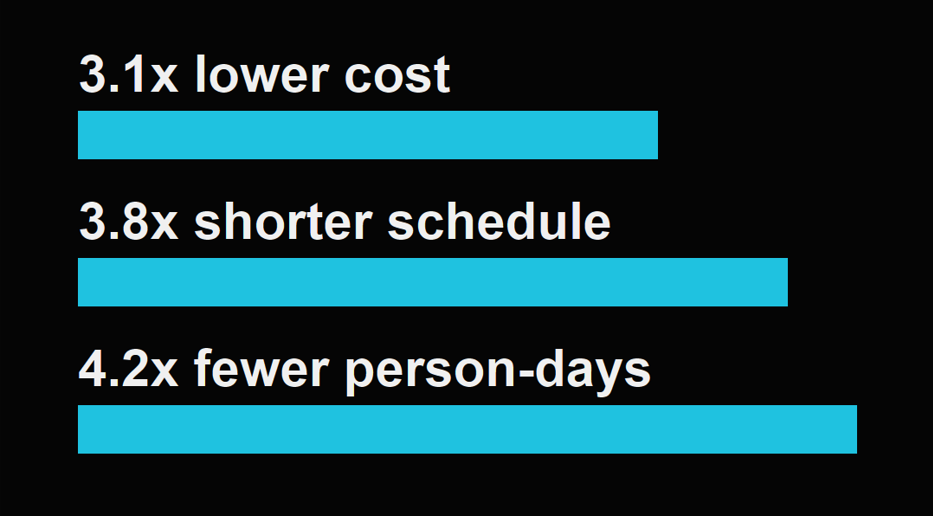
Code per endpoint was about the same, so we avoided the usual AI bloat. Mostly through lots of specs, standards, rules, and hooks. There are also about twice as many test lines per app line. That's a count of tests, not a coverage claim.
Keep in mind
These are production apps with full human oversight on the design, architecture and tech stack. For internal tools, prototypes or similar cases with less oversight and input, the gains are much more pronounced.
We're also probably faster now. The tools keep improving, and so do our specs and rules.
The trick with business is you can't run the simulation twice. Still, it lines up with what we're experiencing: delivering significantly more than before, without the quality drop some expect.